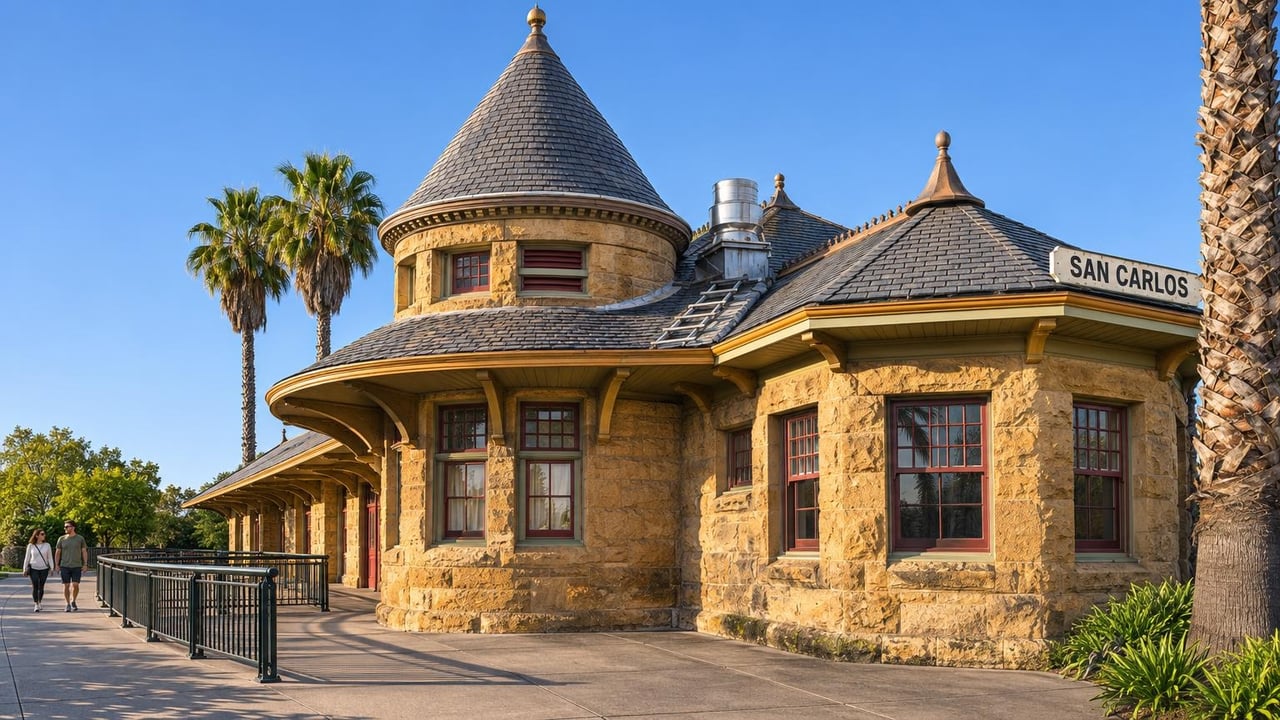
How the Caltrain Commute From San Carlos Compares With Belmont and Redwood City
November 26, 2026
Until the fall of 2024, the San Carlos and Belmont Caltrain stations each had their own set of trains. In Caltrain's diesel timetable effective September 12, 2022, Limited 4 trains stopped at San Carlos and skipped Belmont. Limited 3 trains stopped at Belmont and skipped San Carlos. Baby Bullets and Limited 5 trains passed through both. Anyone comparing the two towns by commute had to check which numbered trains served the stop they had in mind.
That difference is gone. Under electrified service, the two neighboring stations follow the same stopping pattern. For a buyer, the commute question in San Carlos is now a different one, and its answer sits one station south.
Caltrain published a service plan for each city in the summer of 2024, ahead of the September 21, 2024 launch. The San Carlos handout listed 61 weekday stops under the old schedule and 75 under the new one. Peak service stayed at two stops an hour, off-peak went from one to two an hour, and weekend service went from one to two an hour. Belmont's handout had the same final numbers: 60 weekday stops going to 75, two an hour at peak, two off-peak and two on weekends.
The current weekday timetable, effective January 31, 2026, matches those plans. Local trains stop at San Carlos and Belmont. Limited and Express trains pass through both and stop at Redwood City. On a typical weekday morning, northbound train 105 leaves San Carlos at 6:37 a.m., leaves Belmont at 6:39 a.m., and reaches San Francisco's 4th & King station at 7:16 a.m. That is 39 minutes from San Carlos and 37 from Belmont.
So if two homes are the same distance from their station, the train ride from San Carlos and the train ride from Belmont are the same product. The difference between the towns has to come from the house, the street and the walk to the platform. Caltrain service no longer separates them.
Since the two stations have had the same service for about two years, their ridership makes a fair comparison. Caltrain's Fiscal Year 2026 Annual Ridership Report, released in September 2026, covers July 2025 through June 2026. It puts average mid-week trips starting at San Carlos at 885. Belmont's figure is 883.
Belmont's 883 is 123% of its 2019 count of 718. San Carlos's 885 is 66% of its 2019 count of 1,341. In 2019 San Carlos ranked 14th among Caltrain stations by this measure and Belmont ranked 20th. In FY2026 they ranked 18th and 19th, two trips apart. Caltrain lists Belmont among five stations whose FY2026 mid-week ridership was above their 2019 counts. It notes that those stations were among the ones with the largest weekday service increases after electrification.
San Carlos's service increase was nearly identical to Belmont's: 14 added weekday stops to Belmont's 15. Over the same period, San Carlos ridership grew 37% from FY2025, close to Caltrain's systemwide pace. Total ridership was an estimated 12.6 million trips in FY2026, up 37.6% from the year before. San Carlos is growing. It is growing from a lower base than its own 2019 level. Belmont passed its 2019 level on the same trains.
These station figures are Caltrain's estimates of trips starting at each station, built from fare data. They are not the platform head counts Caltrain ran before 2020. They are still the best available measure of how many people board at each stop, and San Carlos and Belmont now draw nearly identical numbers on matching schedules.
Redwood City's service plan looked different from the start. Its handout showed 104 weekday stops under both the old and new schedules, four stops an hour at peak and two off-peak. Weekend service rose from one to two an hour. Electrification did not add trains at Redwood City. Its larger share of trains was already in place.
The current timetable shows what that means at rush hour. Express train 503 leaves Redwood City at 6:49 a.m. and reaches 4th & King at 7:22 a.m., a 33-minute ride. Train 105 leaves San Carlos 12 minutes earlier and arrives in San Francisco six minutes before train 503. The express ride is six minutes shorter. Whether it saves any time depends on how long it takes to get from a particular San Carlos street to the Redwood City platform and how much a full lot there costs in time. Redwood City also has twice as many peak stops an hour, which helps on days when a meeting runs late.
Ridership supports Redwood City's role as the bigger station. It recorded 2,732 average mid-week trips in FY2026, the fifth-highest of any Caltrain station. That is 65% of its 2019 count, about the same recovery rate as San Carlos. Farther north, Hillsdale recorded 2,215 trips and San Mateo 1,720. San Mateo's plan doubled peak service from two stops an hour to four, and Hillsdale's went from three to four. San Carlos and Belmont now share the two-trains-an-hour local tier. Redwood City, Hillsdale and San Mateo are in the four-an-hour tier.
The useful way to think about a San Carlos commute is in two parts. The first is the walk, bike ride or drop-off to San Carlos station, which gets you a 39-minute local ride to San Francisco, with two trains an hour at peak and off-peak under Caltrain's service plan. The second is a backup trip to Redwood City for an express train or the four-an-hour peak service. A house close to San Carlos station makes the first option easy. A house on the south side of town puts the second option closer.
The San Carlos station is set up for both walk-up and drive-up riders. Caltrain lists 251 parking stalls, including seven accessible spaces, along with 24 bike racks, BikeLink lockers and SamTrans connections on the ECR, 260, 295 and 397 routes. The city treats stalls 99 through 197 in the Caltrain lot as free public parking weekdays from 6 p.m. to 6 a.m. and all day on weekends. That lot is also downtown parking in the evening, which we covered in our post on how downtown San Carlos parking changes at 6 p.m.. The station area is also part of a wider city discussion. San Carlos's draft transportation demand management and parking reform work was last updated in October 2026.
For buyers comparing San Carlos with Belmont, Caltrain is a tie. Both towns have the same pattern, two local trains an hour, about the same ride time to the city, and nearly identical mid-week ridership in the latest fiscal year. For buyers comparing San Carlos with Redwood City, Redwood City wins on train service alone. Many San Carlos buyers will weigh that against downtown Laurel Street, the neighborhoods west of El Camino and the rest of what we covered in walkable San Carlos living from downtown to the hills.
Southbound, the ride is short in both directions. Current timetable examples show about 11 minutes from San Carlos to Palo Alto, about 21 to Mountain View and about 39 to San Jose Diridon. A household with one commuter heading north and one heading south can live by the San Carlos platform and have both trips covered by local trains.
Reliability has been steady lately. The San Mateo Daily Journal reported this month that Caltrain's on-time rate was 94.8% as of November 1, 2026, with monthly and weekday ridership up since September 2025. For an all-local stop like San Carlos, that reliability is what keeps the 39-minute ride at 39 minutes.
Does any express train stop in San Carlos? Not in the January 31, 2026 weekday timetable. Express and Limited trains pass through San Carlos and Belmont and stop at Redwood City.
Did San Carlos lose Baby Bullet service with electrification? No. In the 2022 diesel timetable, Baby Bullets already skipped both San Carlos and Belmont. The stops that changed were the Limited trains, which used to split between the two stations.
How many trains stop in San Carlos on weekends? Caltrain's electrified service plan set weekend service at San Carlos at two stops an hour, up from one under the diesel schedule.
How far a home is from San Carlos station, and from Redwood City's express platform, is something we look at when we price a listing and when we help buyers compare streets. If you're weighing a San Carlos home against one in Belmont or Redwood City, or wondering how much your commute options add to your home's value, The Laugesen Team can put both on paper for you. Request a Complimentary Market & Home Valuation.

At The Laugesen Team, we use our expertise and commitment to guide you toward the best possible outcome. Let’s begin your journey today.